
What is Retrofit Lithium LifePo4 Wall Mount Battery? A Complete Guide
A retrofit lithium battery is a LiFePO4 battery built specifically to replace the lead-acid battery inside an existing inverter or UPS — not a general-purpose lithium pack. It gives more usable backup, lasts far longer and weighs a fraction of a tubular battery, but the real engineering is in its BMS.
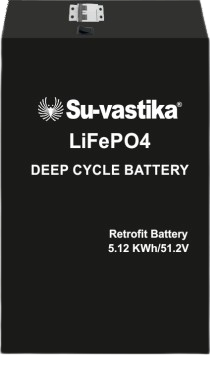
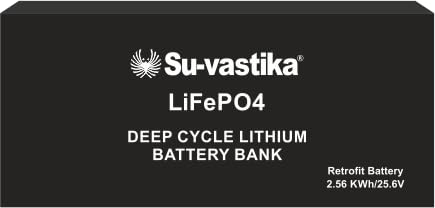
Su-vastika's retrofit LiFePO4 batteries are used in inverters, UPS and online UPS systems, e-rickshaws, golf carts, and lift inverters and Automatic Rescue Devices (ERDs). Each battery's BMS is matched to the target product so it becomes an exact, drop-in replacement for the lead-acid battery. Can you install a lithium battery with your existing inverter?
How is a retrofit battery different from a normal lithium battery?
A normal lithium battery — the kind used in a scooter or an EV — cannot simply be wired into an inverter that was designed for lead-acid. Every inverter already in the field was engineered around a lead-acid battery, and each brand behaves differently. A retrofit battery's Battery Management System (BMS) is designed to work with those inverters; a normal lithium battery is not. Four challenges make this necessary:
- Different starting (inrush) current. Every inverter draws a different surge of current the moment a battery is first connected. The retrofit BMS is built to handle this varying start-up current across the many inverter models on the market; a fixed lithium pack is not.
- Different low-battery cut-off. Each inverter has its own low-battery cut-off point. The retrofit BMS is matched to these varying cut-offs, where a normal lithium battery's fixed high and low limits would clash with the inverter.
- Restarting charge after the cut-off — the hardest part. With lead-acid, when the grid returns the inverter simply begins charging again. With lithium it is not that simple: once the inverter hits its low-battery cut-off, the BMS goes into protection mode and disconnects. When grid power comes back, the battery receives no signal — so a normal lithium BMS stays cut off and never charges. Su-vastika's retrofit BMS solves this by detecting that the grid is back and bringing the battery out of cut-off so charging resumes automatically.
- Tougher safety, because it is not a scooter battery. A scooter or EV battery is charged out in the open. An inverter battery charges continuously, and inverters are often installed in the worst spots — inside an almirah, or a cramped shop with little ventilation. A retrofit battery therefore needs stronger safety and thermal parameters to charge safely, non-stop, in hot, unventilated spaces.
The other advantages over a lead-acid battery
- Much lighter: a tubular 150 Ah lead-acid battery weighs about 62 kg; the equivalent 12.8V 80 Ah retrofit LiFePO4 unit weighs under 10 kg — a big advantage for installation, e-rickshaws and solar-hybrid setups.
- More usable capacity (C1 vs C20): lithium is rated at C1 while tubular lead-acid is rated at C20, so a lithium battery delivers noticeably more real backup for the same nameplate capacity.
- No fumes, no pollution: lead-acid batteries emit harmful lead fumes; these sealed LiFePO4 units emit nothing, so they are safe inside homes and offices.
- Intelligent BMS: the BMS takes full control of charge and discharge current, overload and short-circuit protection — so you no longer depend on the inverter's LEDs or display.
- Up to 3× longer life: a tubular lead-acid battery lasts 2–3 years; a LiFePO4 battery lasts 7–10 years — fewer replacements and lower cost over time.
- Easy drop-in installation: it fits your existing inverter/UPS and any dealer can install it — no complex modifications.
- Safer connections: an Anderson connector replaces the open lead-acid terminals, protecting people and children from accidental shorts — and there is no need for a trolley to keep the battery in a safe zone.
Where retrofit LiFePO4 batteries are used
- Home and office inverters and UPS
- Online UPS systems
- E-rickshaws and golf carts
- Lift inverters and Automatic Rescue Devices (ERDs)
- Solar-hybrid installations
⚡ Size your lithium system in 30 seconds: the free LiFePO4 Lithium Battery & Inverter Calculator gives you the BIS inverter watts, the right single 48V battery (C1 rating) and honest backup time at 82% real inverter efficiency — including the BMS surge check.

Disclaimer: It is important to note that while Mr. Kunwer Sachdev founded Su-Kam Power Systems, he is no longer associated with the company as of 2019. Any information regarding his involvement in the company's operations, strategies, or future plans reflects his tenure prior to that date. Therefore, any discussions or analyses of Su-Kam Power Systems should be considered in the context of his past contributions and not his current association with the company. He currently mentors Su-vastika.
Found this story worth sharing? Post it to your network — it takes one click:
About the Author

Kunwer Sachdev — known as the Inverter Man of India and the Solar Man of India. Founder of Su-Kam, holder of 106 technology filings, and mentor to Su-vastika. Read his story →
Follow on LinkedIn · kunwersachdev.com
Kunwer Sachdev exited Su-Kam in 2019 and is not responsible for any activity of the company since. Full disclaimer →
Part of the Series
Complete Guide to Lithium Batteries for Home Inverters in IndiaExplore Products
Su-vastika Lithium Batteries
25+ patents · Made in India · 10,000+ installations