
Su-vastika Solar PCU 5500: Every Power-Flow Condition, Explained with Diagrams
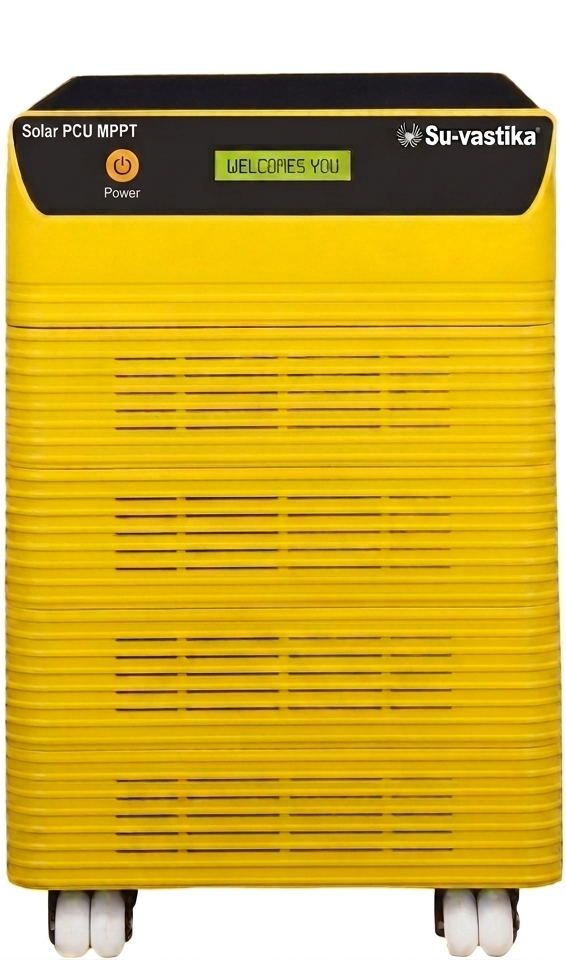
Scroll through each real-world situation — from grid charging to solar sharing to a midnight power cut — each with its own live diagram showing exactly how the current moves.
The seven everyday conditions
Each diagram below animates on its own. Watch the coloured lines flow — solar in green, grid in blue, battery in amber (▼ charging, ▲ discharging) and clean output in purple.
Grid Charging
Battery is low and mains is healthy. Current flows from the grid into the charger and down into the 44V lithium pack (▼), while the same mains supply also powers your home or office. The inverter stays idle — this is the simple top-up state.
Solar Charging
A sunny day with a light load. Solar feeds the MPPT charger and tops up the battery (▼) directly, covering any small load at the same time. The grid contributes nothing and sits on standby — this is free energy doing the work.
Solar + Grid Charge Sharing
A bigger load with both sources available. Solar carries as much as it can and the grid only tops up the shortfall. Both feed the charger, so the battery still charges (▼) while loads run. You draw the fewest possible paid units.
Save-the-Bill (Inverter ON)
Once the battery passes about 50% charge, the UPS deliberately fires the inverter and runs your loads from solar + battery (▲ discharging) even though mains is available — so you spend stored sunshine instead of paid grid units. The grid waits on standby for instant fallback.
Power Cut / Backup
The grid has failed. The inverter instantly runs your loads from the battery (▲ discharging), plus solar if it's daytime. The changeover is synchronised to the AC waveform, so it's fast enough that sensitive electronics barely notice the switch.
Battery Full / Float
The pack is full. Charging tapers to a gentle float trickle (faint ▼) to avoid overcharging, while solar keeps carrying the load. Easing off at the top of the charge is exactly what keeps lithium cells healthy for years.
Low-Battery Sleep
The battery has hit its low cut-off with no grid or solar to recover from. The UPS shuts down its output and drops into a low-power sleep to protect the pack from deep discharge — waking automatically the moment mains or solar returns.
Protection & safety conditions
The controller also watches constantly for trouble and reacts in milliseconds.
Overload
Exceed the rating and the UPS warns, retries a set number of times, then trips to protect the inverter and your appliances.
Short Circuit
A hardware fault line cuts the output almost instantly on a short, then attempts a controlled recovery once the fault clears.
Over-Temperature
The fan ramps with heat; a warning near 90 °C escalates to shutdown near 92 °C. Charge voltage is also trimmed in hot conditions.
Mains Out of Range
If grid voltage or frequency drifts outside the safe window, the UPS won't pass it through or charge from it — it runs on battery.
Battery High-Voltage
Charging stops and a cut-off engages near 51 V to protect the pack, recovering once voltage settles back to ~47 V.
Night Mode
With no solar after dark, the UPS leans on grid charging or battery backup, then re-prioritises solar again at sunrise.
Learn more & where to buy
Solar PCU 5500 · Concept diagrams for illustration · Clean power, smart charging, solar-ready.

Part of the Series
Complete Guide to Lithium Batteries for Home Inverters in IndiaExplore Products
Su-vastika Lithium Batteries
25+ patents · Made in India · 10,000+ installations