
Is a LiFePO4 Inverter Battery Safe? Can It Explode?
Is a LiFePO4 inverter battery safe? Yes — and it is the safest battery chemistry you can put in your home. LiFePO4 (lithium iron phosphate) does not explode the way the batteries in the news do: its chemistry resists thermal runaway to roughly 270°C, it releases no oxygen to feed a fire, and a BMS disconnects it the moment anything goes wrong. Here is what 30+ years of seeing battery accidents has taught me about which batteries actually explode — and why.
Whenever I recommend a lithium battery for a home inverter, one question comes back: “But don’t lithium batteries catch fire?” I understand the fear — everyone has seen videos of a phone or an electric scooter burning. But that fear is attached to the wrong battery. Those fires involve a different lithium chemistry. Meanwhile, the battery that has actually been injuring people in Indian homes for decades is the one sitting quietly in the corner: the tubular lead-acid battery.
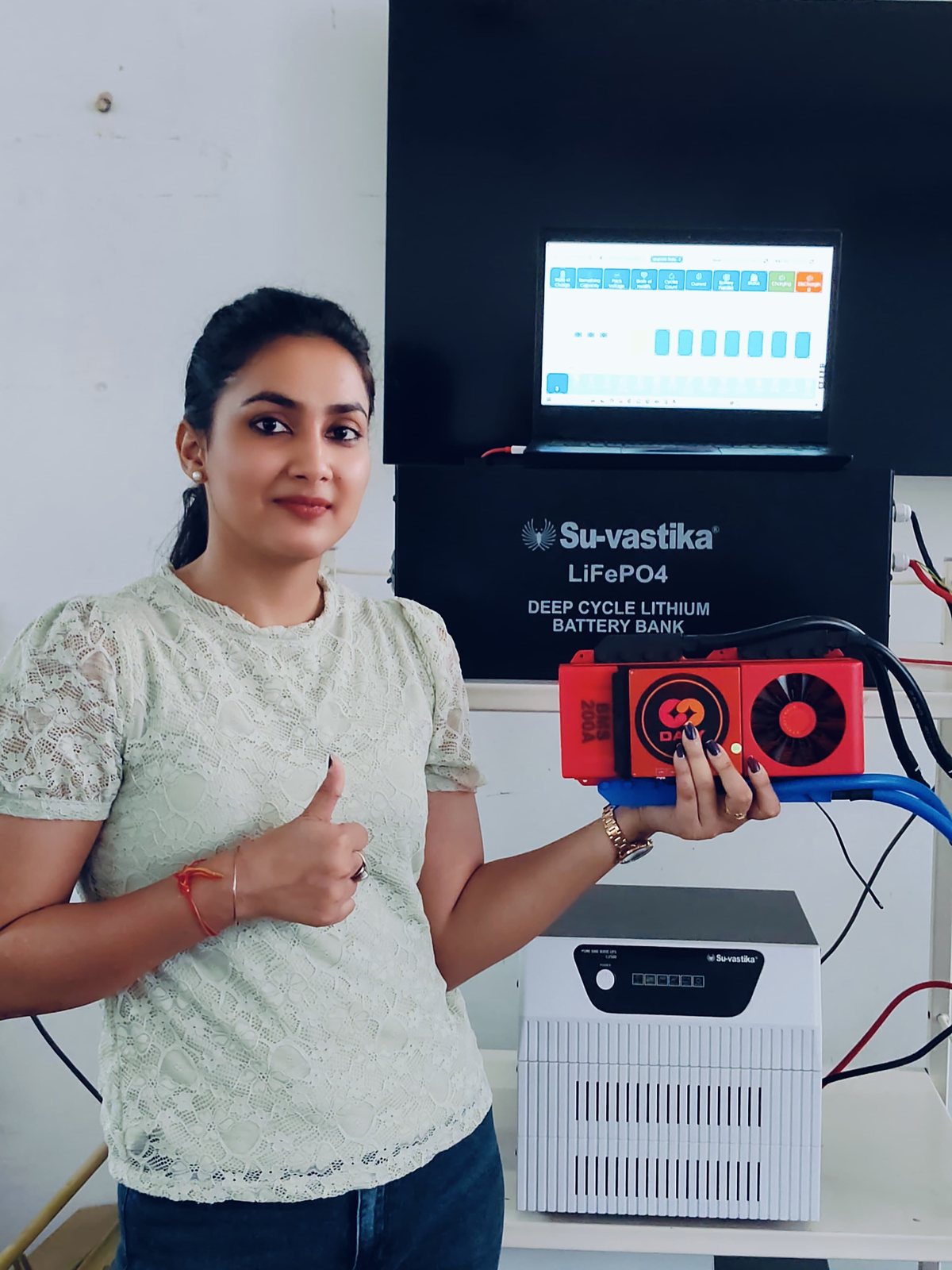
Where the fear comes from — and why it doesn’t apply
The lithium fires you see in the news almost always involve NMC or LCO chemistry (lithium nickel-manganese-cobalt / cobalt oxide) — the high-energy-density cells used in phones, laptops and many EVs. These chemistries pack maximum energy into minimum weight, and the price of that density is a lower thermal-runaway threshold: heat an NMC cell past roughly 150–210°C — through a crash, a puncture, or an unprotected overcharge — and its cathode releases its own oxygen, feeding a fire that is very hard to stop.
A home inverter battery does not need that energy density — it sits on a wall, not in your pocket. So the industry uses LiFePO4 (lithium iron phosphate), a chemistry built for stability instead.
Safety comparison: LiFePO4 vs NMC vs tubular lead-acid
| Safety factor | LiFePO4 | Lithium-ion (NMC) | Tubular lead-acid |
|---|---|---|---|
| Thermal runaway onset | ~270°C | ~150–210°C | N/A (different risks) |
| Releases oxygen in failure | No | Yes — feeds fire | No |
| Explosive gas in daily use | None | None | Hydrogen while charging |
| Acid / electrolyte hazard | Sealed, none | Sealed | Sulphuric acid splash on burst |
| Electronic protection | BMS on every cell | BMS (when present) | None — no brain at all |
| Documented home accidents in India | Extremely rare | Phones/EVs, not inverters | Regular — bursts & acid burns |
The chemistry: why LiFePO4 does not explode
The secret is the phosphate. In LiFePO4, oxygen is locked to phosphorus in a PO4 bond — one of the strongest bonds in battery chemistry. Even if a cell is overheated, punctured or crushed, the cathode does not decompose and release oxygen. A fire needs fuel, heat and oxygen; LiFePO4 refuses to supply the oxygen. That is why its thermal-runaway onset sits near 270°C — a temperature no home installation will ever see — while NMC lets go at barely 150–210°C. This stability is also why serious EV and storage engineering is moving to LiFePO4.
Don’t take the chemistry’s word for it — take the test lab’s. In standard abuse tests — nail penetration, crush, overcharge, external heating — LiFePO4 cells typically vent smoke without exploding, and when a fire does occur it is of far lower intensity than any other lithium chemistry; in the same nail-penetration test an NMC cell ignites almost immediately. Even if a LiFePO4 cell leaks or is heated far beyond its rating, it does not explode. The industry tried many chemistries in the search for a safe storage battery — NMC, LTO and others — and across published abuse testing, LiFePO4 has proven the safest practical balance for home and stationary storage.
The BMS: a guard that lead-acid never had
Chemistry is the first line of defence; the Battery Management System (BMS) is the second. Every proper LiFePO4 pack has one, watching every cell many times a second: over-charge, over-discharge, over-current, short-circuit, cell imbalance and temperature. Cross any limit and the BMS disconnects the battery before anything heats up. It even limits surge current — which is why our LiFePO4 calculator shows the surge amps your appliances will pull, so you can match the BMS rating before you buy. A tubular battery has no brain at all — nothing stops you from overloading it, boiling its electrolyte dry, and walking past it every day as it turns into a pressure vessel.
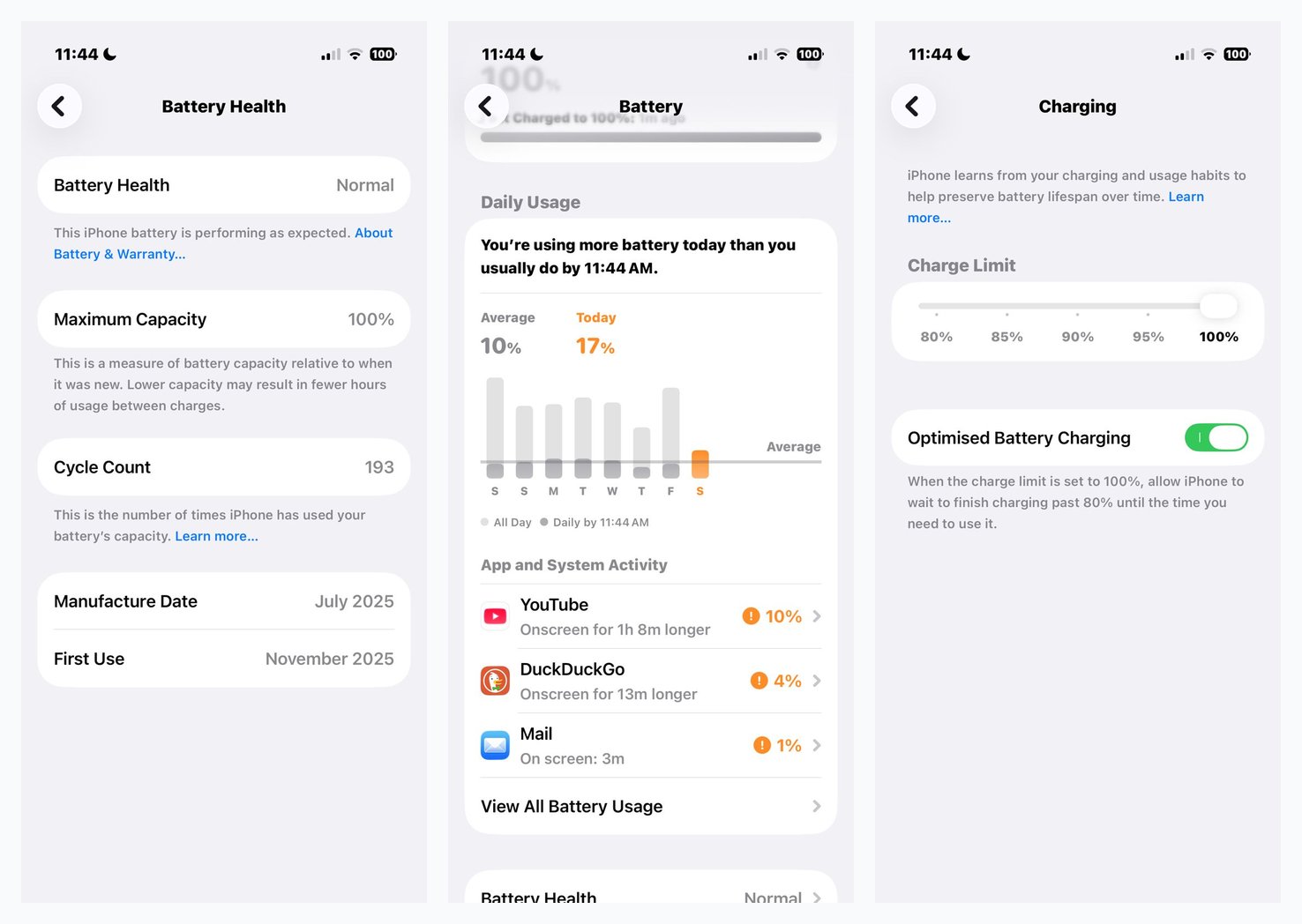
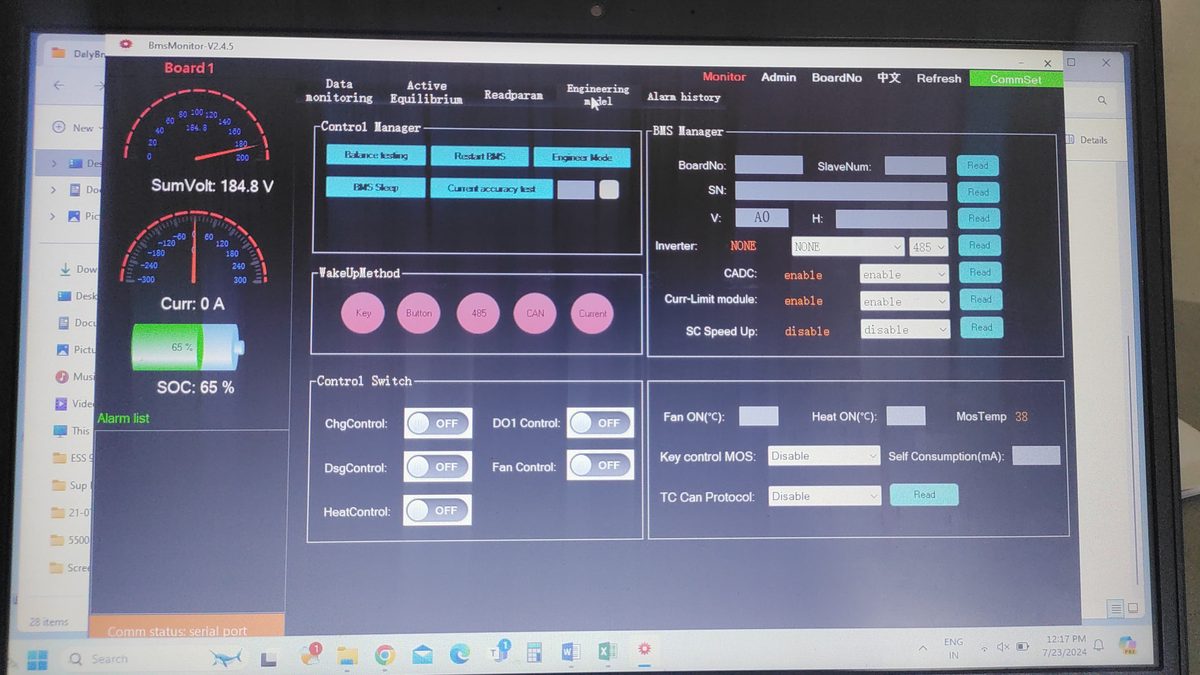
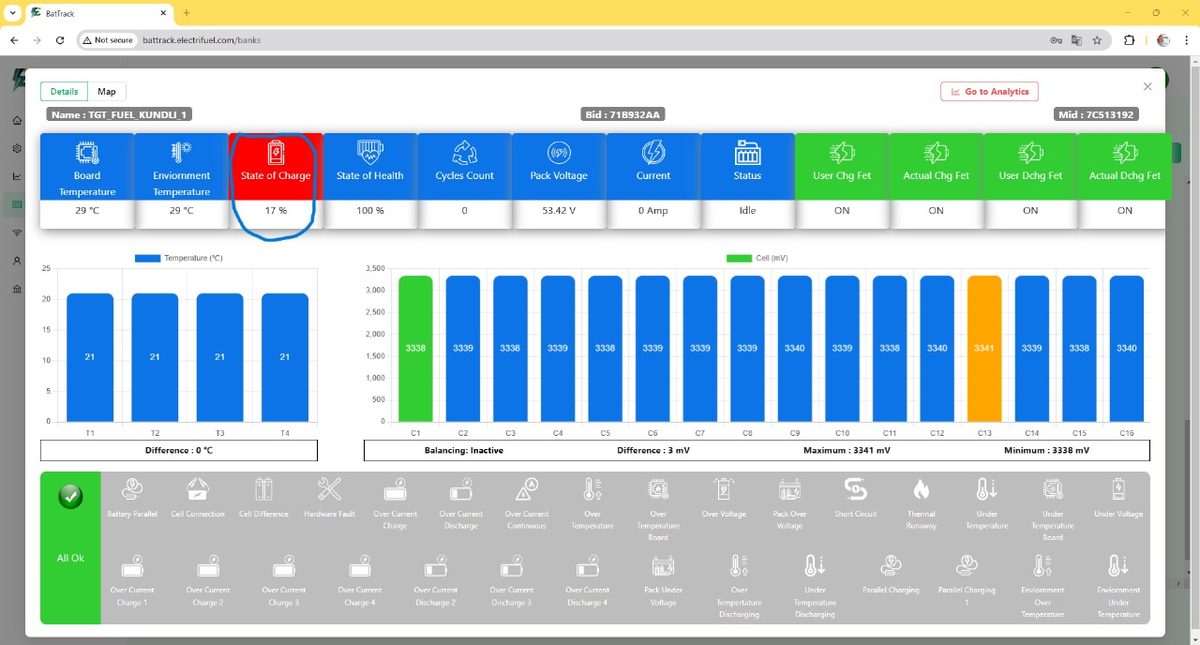
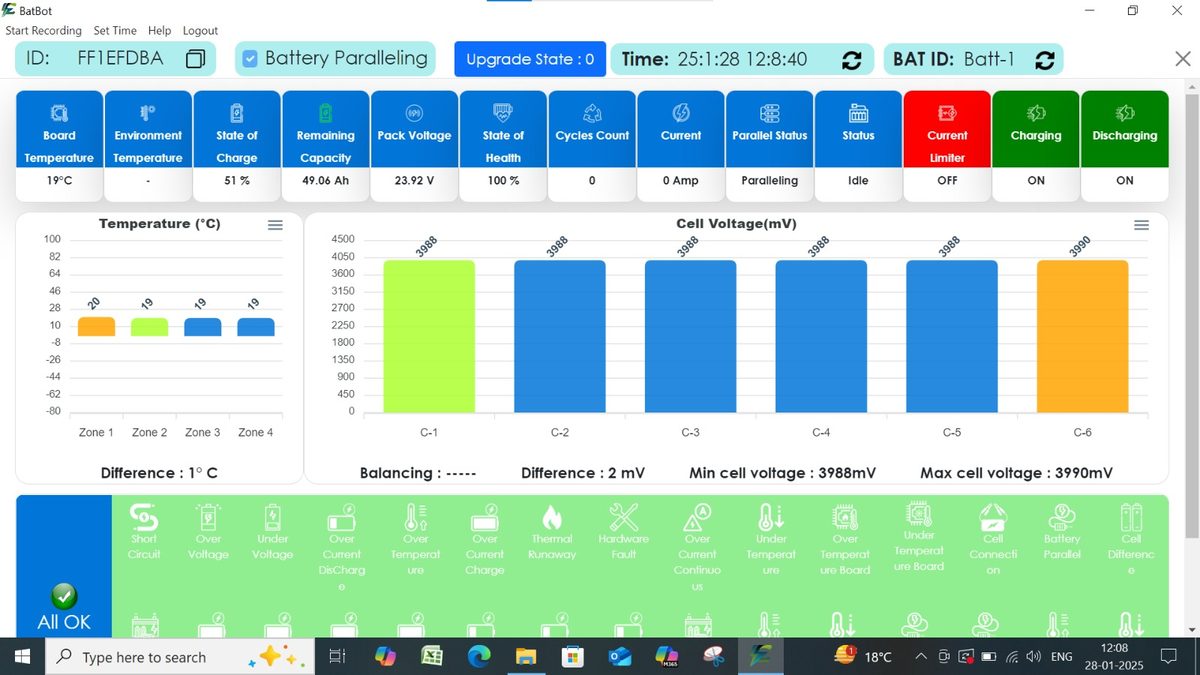
Here is what local dealers — and most customers — do not understand: the BMS defines the real safety of any lithium battery, and today it is also your window into the battery’s health. Just as an iPhone shows “Battery Health” with the maximum capacity percentage and cycle count after months of use, a modern lithium pack’s BMS shows how much capacity remains as the battery ages. Bigger packs go much further: the app shows every individual cell’s voltage, the variation between cells, the temperature of each cell, charge/discharge current, state of charge (SOC) and cycle count. A widening cell-to-cell voltage gap warns you about a weak cell years before it fails. When a dealer cannot show you this data, he is selling you a battery without its brain.
⚡ Size it safely: use the free LiFePO4 Lithium Battery & Inverter Calculator — it gives the BIS inverter watts, the right single 48V battery (C1 rating), honest backup time at 82% efficiency, and the BMS surge check that keeps motor starts from tripping your battery.
When lithium DOES become dangerous
I will not tell you lithium can never fail — honesty is the only safety policy. Every rare lithium incident I have investigated traces back to the same short list: unbranded packs built from recycled or rejected cells, packs sold without a real BMS (or with the BMS bypassed by a roadside repair), chargers with the wrong voltage profile forced onto the battery, severe physical damage, and counterfeit capacity labels that push honest cells beyond their rating. Notice what is missing from that list: properly built LiFePO4 with a working BMS. The danger is not the chemistry — it is the shortcut. The same shortcuts are behind most fire accidents in solar systems in India.
The two honest challenges LiFePO4 still has
LiFePO4 is not magic, and I will name its two real limitations myself. First, low-temperature charging: charging any lithium battery below 0°C causes lithium plating on the anode — permanent capacity damage — which is why packs for colder countries need built-in heaters or strict charge-current limits, and why a good BMS simply blocks charging below its temperature cutoff. For most of India this hardly ever matters; in Himalayan winters it does. Second, cycle life keeps improving but is not infinite — a good LiFePO4 pack delivers around 6,000 cycles, and chemistries like LTO show that 20,000+ is possible, but at a cost and weight the market will not pay today. Neither of these is a safety problem — they are performance boundaries an honest manufacturer states upfront.
What to check before you buy
Ask for four things: LiFePO4 chemistry written on the datasheet (not just “lithium”); BIS registration — the Bureau of Indian Standards covers lithium cells under IS 16046 (IEC 62133); the BMS continuous and surge current ratings in writing; and an honest C1 capacity label. A manufacturer who publishes all four has nothing to hide. This is exactly how we build at Su-vastika — see the complete lithium battery guide for Indian homes and the retrofit guide if you are replacing lead-acid on an existing inverter.
Ready for a battery that cannot become a pressure vessel?
Explore Su-vastika LiFePO4 batteries Size it with the free calculatorFrequently asked questions
Related Su-vastika guides
- Complete guide to lithium batteries for home inverters in India
- The dangers of tubular lead-acid battery explosions — and how to prevent them
- BMS: essential for safe and efficient lithium battery performance
- Difference between tubular and lithium battery

Disclaimer: It is important to note that while Mr. Kunwer Sachdev founded Su-Kam Power Systems, he is no longer associated with the company as of 2019. Any information regarding his involvement in the company’s operations, strategies, or future plans reflects his tenure prior to that date. Therefore, any discussions or analyses of Su-Kam Power Systems should be considered in the context of his past contributions and not his current association with the company. He currently mentors Su-vastika.
Found this story worth sharing? Post it to your network — it takes one click:
About the Author

Kunwer Sachdev — known as the Inverter Man of India and the Solar Man of India. Founder of Su-Kam, holder of 106 technology filings, and mentor to Su-vastika. Read his story →
Follow on LinkedIn · kunwersachdev.com
Kunwer Sachdev exited Su-Kam in 2019 and is not responsible for any activity of the company since. Full disclaimer →
Part of the Series
Complete Guide to Lithium Batteries for Home Inverters in IndiaExplore Products
Su-vastika Lithium Batteries
25+ patents · Made in India · 10,000+ installations